All Insights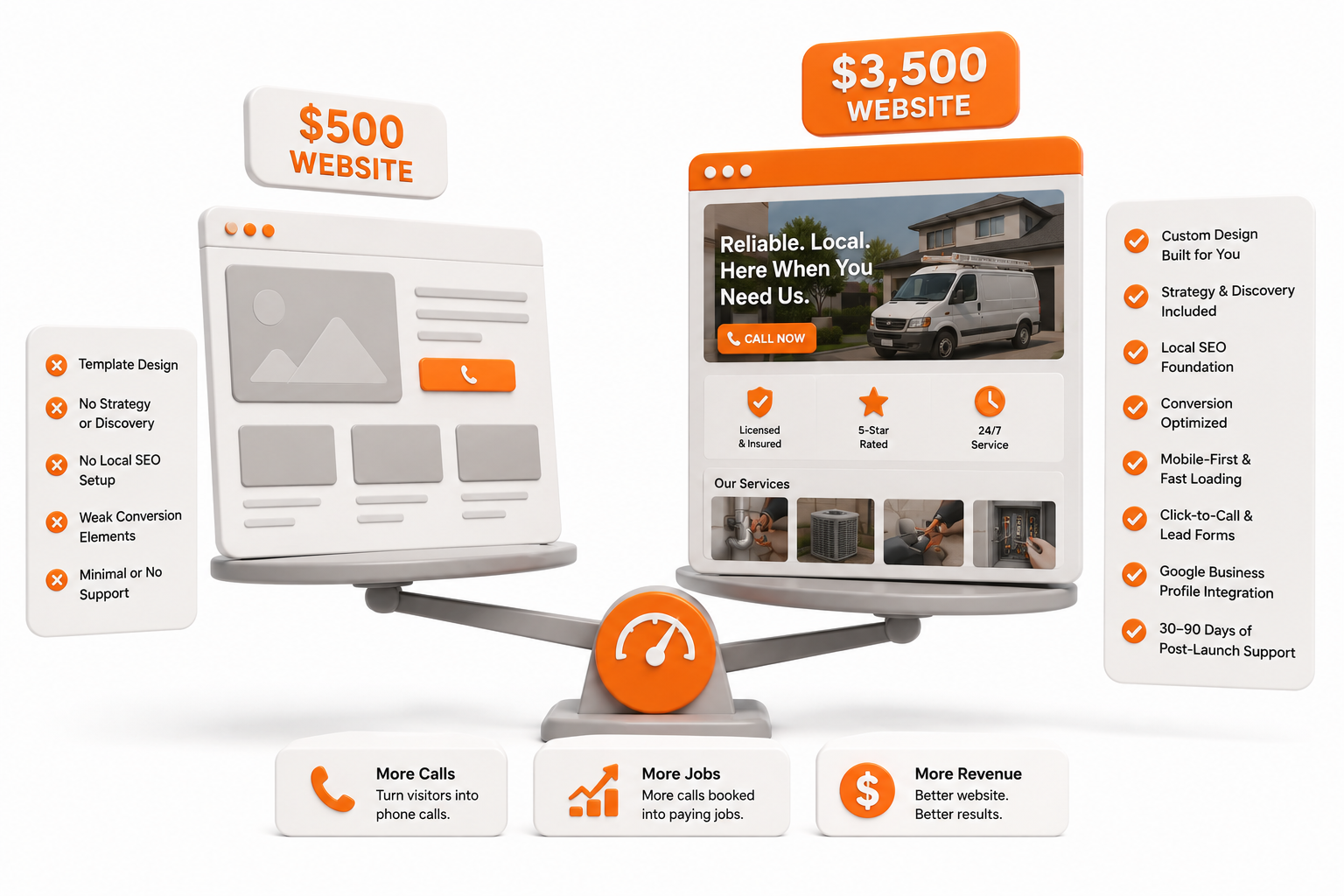
Feb 17, 2026•5 min read
What a $3,500 Website Gets You (Compared to a $500 One)
A side-by-side breakdown of where the money actually goes, and why the difference matters.
The most common pushback we hear is some version of: "I saw someone online offering websites for $500. Why would I pay $3,500?" It is a fair question. Here is the honest answer.
What a $500 Website Actually Is
A $500 website is almost always a template with your business name and phone number dropped in. The person building it is either working very fast, using pre-built assets with minimal customization, or both. That is not a criticism. It is simply what $500 buys.
At that price point, you typically get:
- A template design that may look familiar because you have seen it on other sites
- No discovery conversation about your business or your customers
- No local SEO setup, keyword research, or page structure for ranking on Google
- No conversion strategy: where do you want visitors to go, and what do you want them to do?
- Limited or no support after the site goes live
It is a digital business card. That might be enough if you just need something to exist. It is not enough if you want the phone to ring.
What a $3,500 Website Actually Is
At this price point, the process looks fundamentally different. Before a single pixel is designed, there should be a real conversation about who your customers are, what makes you different from your competitors, and what action you want visitors to take.
A professional build in this range includes:
- Custom design built around your brand and your specific customers, not a template
- Mobile-first development, because over 60% of local service searches happen on phones
- Page speed optimization, because every second of delay costs you calls
- Local SEO structure: page titles, meta descriptions, schema markup, city-specific content
- Click-to-call buttons and contact forms optimized to convert visitors into leads
- Google Business Profile integration and setup
- 30 to 90 days of post-launch support for tweaks and changes
The goal is not a website that looks nice in a presentation. The goal is a website that generates calls.
The ROI Math
A pool services company increased year-over-year revenue by 46% after a strategic website redesign focused on clarity, mobile performance, and stronger calls to action. The investment paid for itself several times over before the year was out.
The math is simple for any service business. One additional call per week at a $300 average job value adds $15,600 in revenue over a year. The $3,000 difference between a $500 site and a $3,500 site pays for itself the first month it generates one extra job.
The Question That Actually Matters
Before comparing prices, ask what this website is supposed to do for your business. If the answer is "generate leads," treat it like a lead generation tool, not a cost to minimize.
The cheapest website is only a good deal if it actually works. Most cheap ones do not.